

Nordic-Baltic Hydrogen Corridor
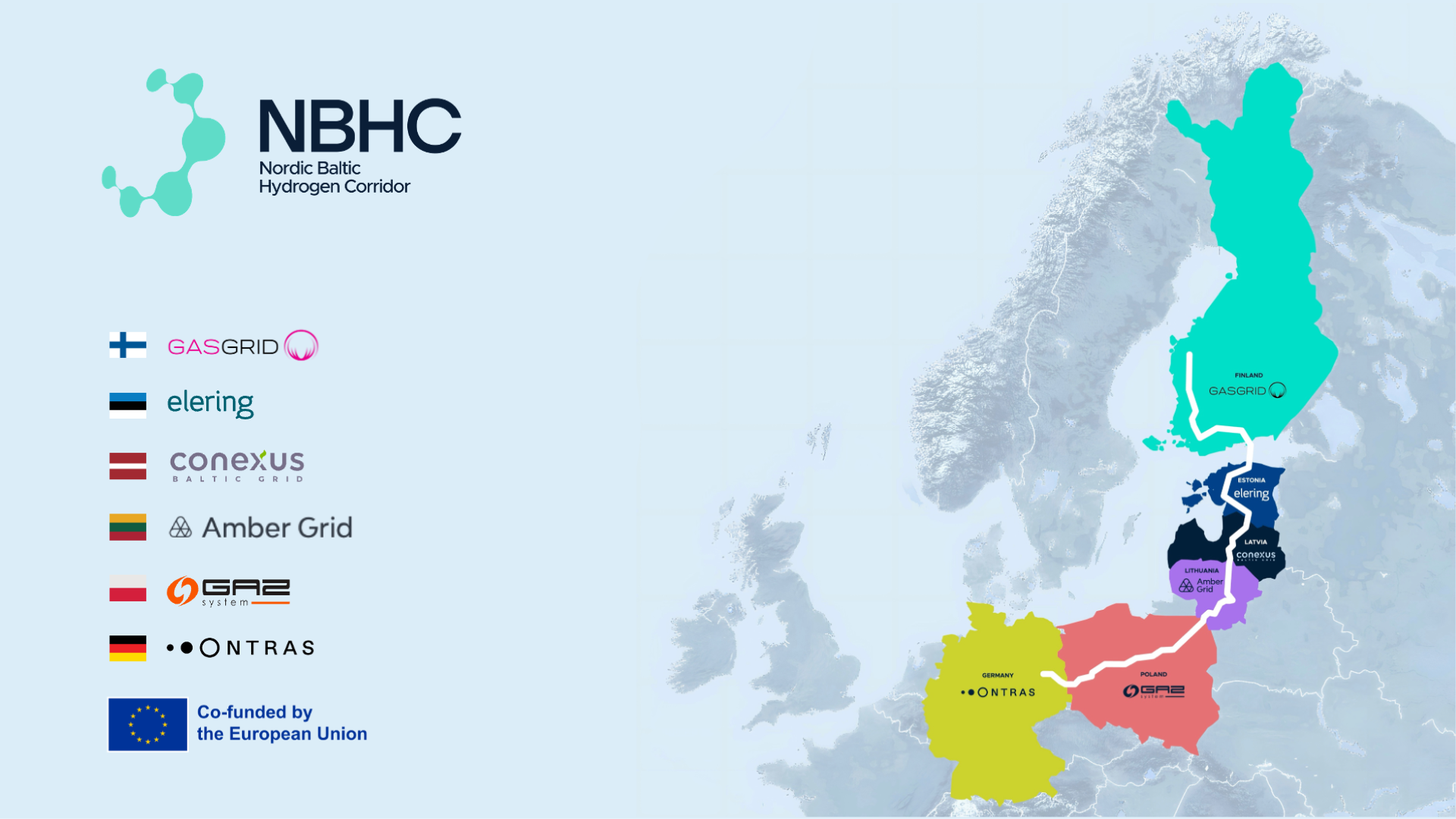
The Nordic Baltic Hydrogen Corridor (NBHC) is an international project involving the construction of major hydrogen transmission infrastructure connecting Finland, Estonia, Latvia, Lithuania, Poland and Germany. The project is being implemented jointly by the transmission system operators from the following countries:
- Gasgrid Finland (Finland)
- Elering (Estonia)
- Conexus Baltic Grid (Latvia)
- Amber Grid (Lithuania)
- GAZ-SYSTEM (Poland)
- ONTRAS (Germany)
The project aims is to create a new cross-border corridor from Finland, across the Baltic States and Poland, to Germany. The completion of the NBHC will unlock the significant hydrogen potential of the eastern Baltic Sea region and ensure access to stable supply of renewable and low-carbon hydrogen for the countries through which the transmission infrastructure will be routed.
Access to low-carbon hydrogen is set to strengthen the Baltic region’s energy security, reduce dependence on imported fossil fuels and play a significant role in the decarbonisation of industry in the countries located along the corridor, including Poland. The project is also expected to contribute to the achievement of the European Union’s ambitious climate goals, relying on the decarbonisation of economies based on stable sources of renewable and low-carbon energy located within EU and NATO member states. When combined with geographical proximity, this will enhance the security of energy supply.
The project is firmly aligned with the EU hydrogen strategy and REPowerEU plan. In addition, the Nordic-Baltic Hydrogen Corridor will support several regional and EU climate objectives, such as the EU Green Deal and Fit for 55 package.
PCI
The Nordic Baltic Hydrogen Corridor has been included for the second time in the list of Projects of Common Interest (PCI) under the BEMIP Hydrogen initiative aimed at developing interconnections in the Baltic States’ energy market.
EU co-financing
The project promoters are conducting detailed technical, economic and financial analyses. This work was granted approx. EUR 6.8 million from the Connecting Europe Facility (CEF).
Project status
Given the complexity of the project, the partners have undertaken coordinated and proactive measures to ensure its success. A cooperation agreement for the joint implementation of the project was signed in December 2022.
Following the tender process, GAZ-SYSTEM and the European partners, signed an agreement for the preparation of a pre-feasibility study for the corridor. The work was completed in early July 2024. The study defined key project parameters, comprising technical, legal, organisational and economic aspects, and provides the basis for developing a roadmap for further project implementation.
Results of the pre-feasibility study
Analyses have shown that the Scandinavian and Baltic Sea region has significant potential for renewable hydrogen production. By 2040, it will be possible to produce approx. 27.1 million tonnes of hydrogen annually from offshore and onshore wind power and solar energy. This creates favourable conditions for the development of the hydrogen market and its export to the mainland Europe, which is what the NBHC project is designed to facilitate.
It is estimated that by 2040, the corridor will allow annual cross-border transmission of up to 2.7 million tonnes of renewable hydrogen. The pre-feasibility study has confirmed that the NBHC may become one of the first operational cross-border hydrogen pipelines in Europe. The proposed infrastructure comprises an approx. 2,500 km long pipeline with a diameter of approx. 1,200 mm and featuring several compressor stations.
Feasibility study phase
Based on the conclusions drawn from the analyses made during the pre-feasibility study phase, in the second half of 2024 the partners of the Nordic-Baltic Hydrogen Corridor moved on to the feasibility study, which includes detailed technical, economic and commercial analyses.
Further steps
The results of these analyses will determine the next project stages and the prospects for the construction of a new cross-border hydrogen corridor.
The Nordic-Baltic Hydrogen Corridor launches Call for Interest
The results are based on 93 survey responses received from 81 companies representing 108 projects in total.
The findings reveal considerable market interest in the implementation of the NBHC project, corresponding to initial technical projections. According to the forecasts, by 2040, annual demand for hydrogen transmission is expected to reach 79.2 TWh, of which 64.4 TWh will be accounted for by industrial projects and 14.8 TWh by German distribution networks, corresponding to approximately 87% of the assumed corridor’s capacity of 91 TWh.
The survey also demonstrates that heavy industrial consumption will consistently outpace domestic supply of hydrogen in Poland, where production is expected to increase from 2.8 TWh in 2033 to 13.2 TWh by 2050, whilst demand will grow from 11.8 TWh to 32.4 TWh over the same period.
Project promoters intend to continue market dialogue to specify the demand for NBHC capacity and the optimum options for infrastructure development.
Nordic-Baltic Hydrogen Corridor (NBHC) Call for Interest 2026: Results Report - prestenation,
Media inquiries
GAZ-SYSTEM is a company of strategic importance for the Polish economy. It is responsible for the transmission of natural gas, manages the most important gas pipelines in Poland, owns and operates the President Lech Kaczynski LNG Terminal located in Świnoujscie.
- Contact: Mrs. Agnieszka Głośniewska, Spokesperson, GAZ-SYSTEM, agnieszka.glosniewska@gaz-system.pl, tel. +48 887 060 952
Gasgrid Finland Oy is a Finnish state-owned company and a transmission system operator with system responsibilities. It offers its customers safe, reliable and efficient gas transmission. With its customer-oriented approach, the company is active in developing its transmission network, services and the gas market to promote a carbon-neutral energy system of the future. Read more: www.gasgrid.fi
- Contact: Sara Kärki, Head of Strategic analysis & RDI, Gasgrid Finland, sara.karki@gasgrid.fi, +358-40-1581722
Elering is the Estonian electricity and gas transmission system operator, which manages a pipeline network spanning 977 km including a subsea connection to Gasgrid Finland. To ensure sustainable functioning and security of supply as a critical service, Elering maintains and develops both its internal electricity and gas transmission networks and interconnections with other systems. In its operations, Elering is guided by the principle of an open energy market, being conscious of its responsibility to ensure proper functioning of the market and equal treatment of all its participants. Read more: https://elering.ee/en
- Contact: Siim Iimre, Research and Development Manager, Elering, siim.iimre@elering.ee
Conexus is the sole operator of natural gas transmission and storage in Latvia and provides registered businesses with access to the Latvian natural gas transmission system for trading gas not only in Latvia but also in the neighbouring countries, whilst also offering storage services to both local and foreign entities. In total, Conexus manages 1,190 km of high-pressure gas transmission pipelines covering regions in Latvia and delivering natural gas to the local gas distribution system by means of 40 pressure regulating stations. In addition, Conexus manages the Inčukalns UGS, which is the only natural gas storage facility operating in the Baltic States, with a capacity of 24 TWh. Read more: www.conexus.lv.
- Contact: Aleksejs Batrakovs, Head of Technical Development division, Conexus Baltic Grid, aleksejs.batrakovs@conexus.lv, +37128322622
Amber Grid is the operator of the Lithuanian gas transmission system. The company operates 2,285 km of high-pressure gas pipelines, gas distribution stations and two compressor stations. The Amber Grid system is interconnected with the transmission systems of four other countries and the LNG terminal in Klaipėda. The highly developed Lithuanian transmission system serves as a regional hub for gas transmission southwards to Poland and northwards to Latvia. Their system connects the Baltic and Finnish transmission systems with the EU gas network and market. In pursuit of the decarbonisation targets for the gas sector, Amber Grid is actively analysing the potential and conditions for adapting the Lithuanian transmission system to transport green gases, including hydrogen. Read more: www.ambergrid.lt
- Contact: Laura Šebekienė, Head of Communications, Amber Grid, l.sebekiene@ambergrid.lt, +370 699 61246
ONTRAS Gastransport operates the 7,700 km long gas transmission system in eastern Germany and is responsible for reliable and efficient transport of gaseous energy – today and in the future. The company is actively shaping the energy market of the future, contributing ideas and developing sustainable solutions for their infrastructure. In doing so, ONTRAS draws on reliable technology, many years of experience and their most important asset: a committed team. Their gas infrastructure is compatible with renewable gases and thus also supports a variety of use cases for hydrogen such as production of materials, mobility and heat generation. In order to make their infrastructure fit for a renewable gas supply, they plan and implement numerous projects in collaboration with partner companies. Read more at www.ontras.com.
- Contact: René Döring, Advisor Asset development/Simulation, ONTRAS Gastransport, ene.doering@ontras.com, +49 341 27111 2771
